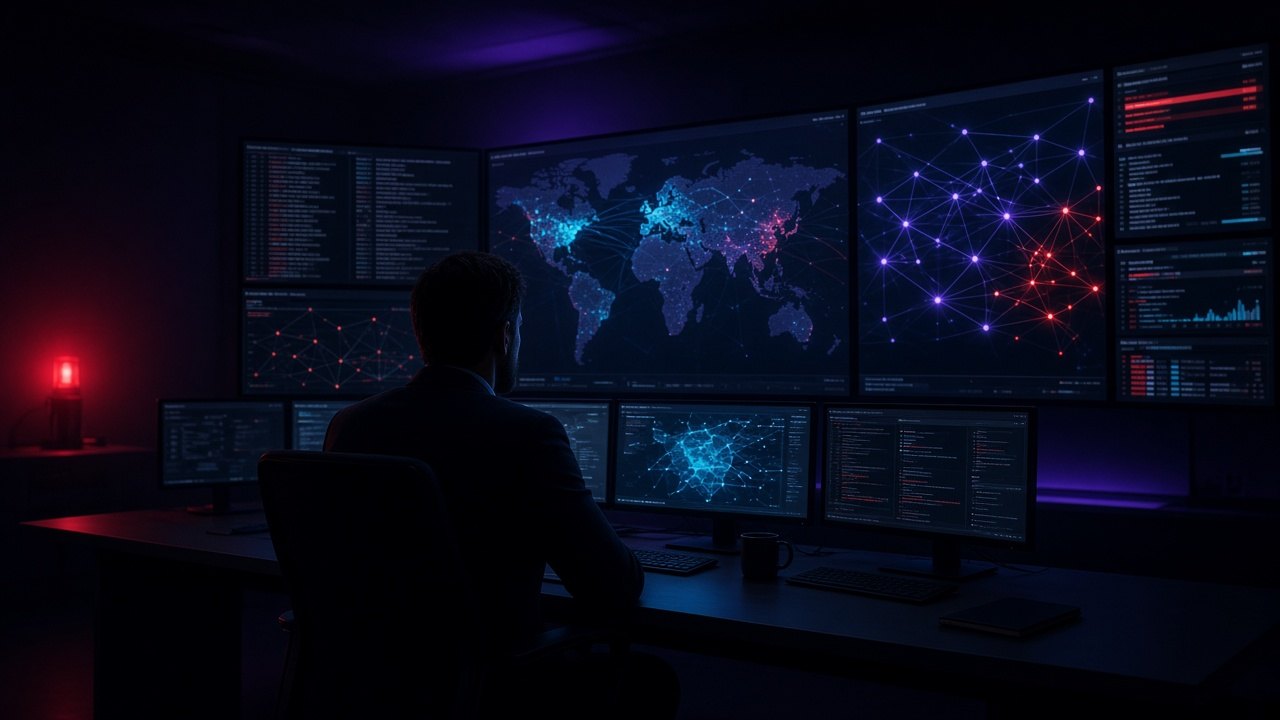
At three in the morning, the CISO of a major airline group's phone rings. On the screen, a technical alert: a JavaScript file hosted on a trusted CDN—the one belonging to an experimentation tool used by hundreds of companies—has just served malicious code to visitors. Among the affected domains are those of the company, its low-cost subsidiary, and potentially those of thousands of travelers checking their reservations. The dilemma is immediate and stark: should this third-party script be removed from all production pages, risking a broken user experience and blocked booking flows, or should they wait for the provider's official confirmation to act with certainty, at the risk of exposing more customers to malware capable of intercepting banking data? This decision, made in minutes under pressure, does not stem from a written procedure. It stems from the attestation of commitment that L'Attaque by Predictive CyberProgram makes leaders experience concretely.
The trap of delegated trust
The compromise of a shared provider illustrates a reality CISOs know too well: your website's security now depends as much on your vendors' security as on your own. When a browser loads a file from a legitimate CDN domain, it does not trust your company, but the third party's infrastructure. When that infrastructure is compromised, every page of your site becomes a potential vector, without your own servers having been breached. For the decision-maker, this means the threat does not knock on the door of your internal IS: it slips through the window you voluntarily left open because that script brought business value—personalization, A/B testing, audience measurement.
In this context, waiting for the provider's official statement before acting is not a prudent option: it is a risky bet. Attackers exploit precisely this latency. Between the moment malicious code is injected and the moment the vulnerability is patched and communicated, thousands of sessions can be compromised. The CISO then faces a calculation of uncertainty: what is the probability that my customers are affected? What are the potential damages—banking data theft, cryptocurrency diversion, mobile device compromise? And above all, what is the cost of inaction compared to the cost of a brutal service cut?
Cut or wait: the decision at time T
The decision to remove a third-party script in the middle of the night is not trivial. It can lead to immediate degradation of the customer experience: interrupted booking journeys, unavailable personalization features, loss of analytics data. Yet leaving a compromised script running means potentially exposing travelers to sophisticated malware capable of diverting cryptocurrency transfers or intercepting sensitive information. The decision-maker must arbitrate between two risks:
- Immediate operational risk: breaking the service and losing revenue.
- Cyber risk: letting the attack run and exposing customers to data theft.
This decision cannot be delegated to a committee that would meet in three days. It must be made by an individual, or a reduced crisis cell, with the necessary authority and a clear understanding of business stakes. This is precisely the kind of moment that L'Attaque reproduces under real conditions: not to teach procedures, but to forge the reflex of decision under pressure, when information is incomplete and time is pressing.
Why classic awareness fails at this precise moment
Traditional awareness programs (videos, quizzes, email reminders) poorly prepare for this type of crisis. They teach the theory of third-party risk, but not the practice of real-time decision-making. When a CISO has completed an e-learning module on vendor management, they know they must monitor their providers. But do they know how to decide, at 3 a.m., facing an ambiguous technical alert, whether to cut a script that drives a significant portion of their online revenue? The answer is no, as long as they have not lived through this pressure.
Predictive CyberProgram's know-understand-act arc places action at the center. Understanding the software supply chain is good. But acting means being able to say "we cut now" or "we isolate this domain immediately," even without absolute certainty, and assuming the consequences of that decision. It is this attestation of commitment—the capacity to decide and assume under pressure—that L'Attaque forges in leaders and security teams.
Measuring real decision capacity with Predictive CyberScore
If L'Attaque trains for decision-making, Predictive CyberScore (PCS) measures it. How do you know if your teams are truly ready to face this scenario of critical provider compromise? Not by counting the number of trainings completed, but by evaluating their real behavior in simulated crisis situations. The HVS (Human Vulnerability Score) identifies human fragilities in the decision chain—for example, the tendency to wait for official confirmation to the detriment of preventive action—while h-ROSI (human Return On Security Investment) quantifies the return on investment of human preparation: how many correct decisions under pressure does a leader trained by L'Attaque generate, compared to an unprepared leader?
For an Executive Committee, these indicators offer a concrete reading: is your organization vulnerable not technically, but humanly, to a supply chain attack? Do you have individuals capable of making the decision to cut a critical service at 3 a.m. to protect your customers, or do you depend on processes that will take 48 hours to get moving?
Governing third-party risk in crisis time
The compromise that affected 178 organizations—from airlines to banks to cryptocurrency players—reminds us that no one is immune to an attack via a common provider. The question is therefore not whether this will happen, but whether, on D-day, your organization will have a decision-maker capable of acting on uncertainty. Third-party risk governance is not limited to contractual clauses or annual audits: it requires individuals capable of deciding quickly, with partial information, and assuming the consequences of their choice.
This is why L'Attaque and Predictive CyberScore work together: one forges the attestation of commitment through immersive practice, the other measures and steers this capacity at the leadership level. Because in the end, cybersecurity is not played out in audit reports, but in the capacity of a human being to make the right decision when the phone rings at 3 a.m.